
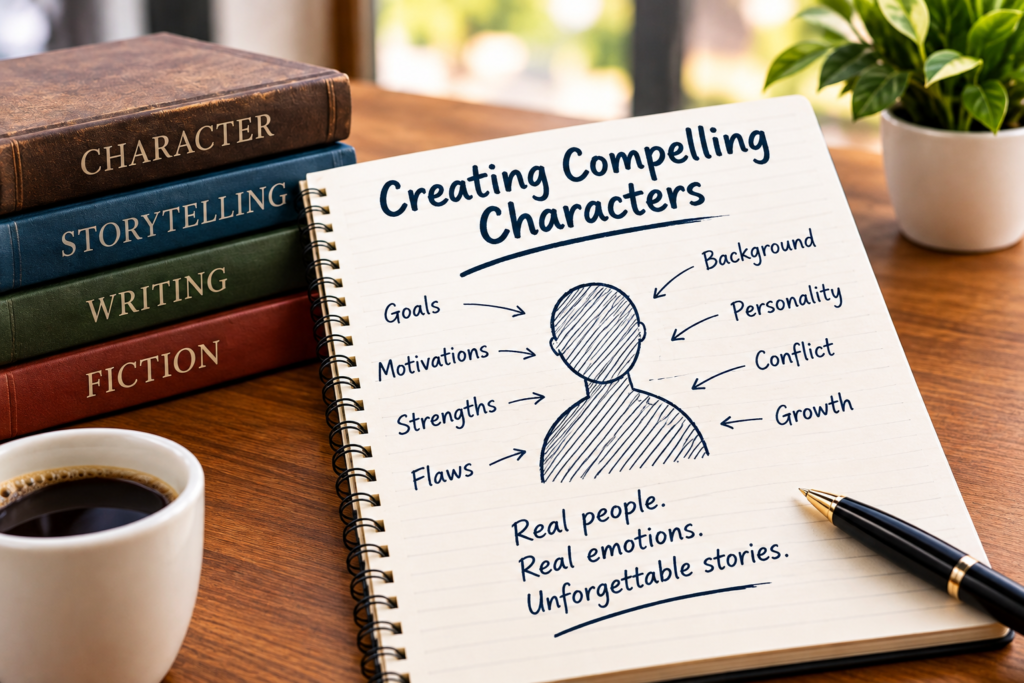
Characters are the people—or imagined individuals—who bring a story to life. They are the ones who do things, make decisions, create problems, solve problems, fall in love, fight, fail and grow. In dialogue, they are also the ones doing the talking.
Think about the people you meet in real life. No two people are exactly alike. They have different backgrounds, personalities, habits, fears, dreams and ways of speaking. Your fictional characters should feel just as real. When readers begin to feel that your characters could walk out of the pages and into the real world, you know you are doing something right.
Start with the protagonist
The protagonist is the main character—the person whose journey usually drives the story. If the protagonist is your hero, you want readers to care about them. But don’t simply tell readers that your character is good. Show them why they should like the character.
Give readers a reason to become emotionally attached.
Perhaps your protagonist fixes a stranger’s car without asking for payment. Maybe they stop to rescue a drowning puppy. Perhaps they stand up for someone who is being bullied. These small actions, especially when they appear early in the story, can quickly tell readers what kind of person they are dealing with.
Your protagonist doesn’t have to be perfect. In fact, characters with flaws can be much more interesting. What matters is giving readers something to care about.
And then there’s the antagonist
If the protagonist is the character readers are rooting for, the antagonist is often the person standing in their way.
You can make an antagonist unpleasant from the beginning by showing their behavior rather than simply calling them evil. For example, imagine a character who walks past a beggar and deliberately shoves them into the street. That single action tells us quite a lot about the person.
But remember: villains can have depth too. A character can do terrible things and still have a history, motivation or vulnerability that makes readers curious about them.
Don’t forget the supporting cast
Not every character needs to be the hero or the villain. Secondary characters can be the hero’s best friend, the villain’s sidekick, a love interest, a mentor, a rival, a family member or simply someone caught in the middle.
Sometimes a secondary character can become just as memorable as the protagonist. Give them enough personality to make them feel like people rather than furniture placed in the background.
Make them feel real
One author who was particularly good at creating compelling characters was James Hadley Chase. If you have read his novels, you may remember how naturally his characters seemed to come alive. When the story required you to dislike someone, you disliked them. When it asked you to sympathize with someone, you found yourself doing exactly that.
That is the power of good characterization. So, how do you create characters that feel real?
Give them a backstory
Every person has a history, and your characters should have one too. A character’s backstory helps explain who they are, why they behave the way they do and how they acquired their abilities, fears and beliefs.
Avoid suddenly giving a character a remarkable skill simply because the plot needs it. If your character outruns a professional athlete during an important scene, readers should have some reason to believe they could do it. Perhaps earlier in the story, we learn that the character was a talented 100-metre runner at school. That small detail prepares readers for what comes later. In other words, plant the seed before you reveal the surprise.
Age matters
Can you imagine a person without an age? Age influences how people think, speak, behave and make decisions. Let your readers have some idea of how old your important characters are.
You don’t always have to give an exact number. You can describe someone as a teenager, a person in their mid-twenties or a septuagenarian. Sometimes leaving the exact age open can even make a character more intriguing.
Help readers see them
Your characters may not physically appear before your readers, but they should be visible in their imagination. Describe their appearance clearly enough for readers to form a picture. What do they look like? How do they dress? Are they tall, short, muscular, thin, stylish, untidy or distinctive in some other way?
Of course, every reader may imagine the character slightly differently. That’s part of the magic of reading. Your job is not necessarily to control every detail of the picture, but to give readers enough material to create a convincing one.
Give them personality
Real people have strengths and weaknesses. They have things they love and things they hate. They have fears, ambitions, habits, secrets, preferences and insecurities. Your characters need these things too.
Imagine that your character is trapped alone in a sinking boat—and you have already established that they are hydrophobic. Suddenly, the situation becomes much more intense. Readers know what the character fears, so they become anxious to discover what happens next.
Even something as simple as food can reveal character and culture. A food considered a delicious delicacy in one culture may be completely unappealing to someone from another. If, for instance, you create a character from Southern Africa and snails a traditional part of the diet, that doesn’t add up, but one from West Africa will most likely have them for lunch. These differences make characters more believable.
Let their culture influence them
People from different places don’t always speak or behave in the same way. An American may say “truck,” while a British character may say “lorry.” Similar differences can appear in clothing, gestures, habits, greetings and everyday expressions.
But be careful with cultural assumptions. Avoid turning stereotypes into rules. Instead, use cultural details thoughtfully and give individual characters their own personalities.
The same applies to language. A character’s country, community, education and personal experiences can all influence the words they choose.
Education shapes characters too
Education can also influence characterization. A highly educated character and someone with very little formal education may approach the same problem differently. Their vocabulary, confidence, assumptions and decision-making may vary.
However, education should not be used to suggest that one character is automatically wiser or better than another. People are more complicated than their academic qualifications.
Characters can change
Consistency is important, but that doesn’t mean your characters must remain exactly the same from beginning to end. People change—and fictional characters can change too.
A character who begins the story struggling with drug addiction may enter counseling and gradually rebuild their life. Someone who moves to another country may learn a new language, make new friends and adapt to a different way of life. These changes can make a story even more powerful because readers get to watch a person evolve.
The important thing is to make the transformation believable. Give readers the experiences, struggles and decisions that lead to the change.
Don’t overload one character
Finally, remember that you don’t have to give every character every possible trait. You don’t need a character who is simultaneously a brilliant athlete, genius scientist, millionaire, musician, chef, philosopher and martial artist—unless your story genuinely calls for it.
Choose the characteristics that matter most to the story. A few well-developed traits can tell readers much more about a character than a long list of unnecessary details.
Good characterization is not about creating perfect people. It is about creating believable people.
Give your characters histories, personalities, fears, desires, cultures, strengths and weaknesses. Let them make mistakes. Let them surprise us. And, when the story demands it, let them change. When readers begin to laugh with your characters, worry about them, dislike them, sympathize with them or even miss them when they are gone, you have created something special: characters who feel alive.

